Resistance Bands for Calisthenics: Types, Sizes and Uses
Guide to resistance bands: assisted pull-ups and muscle-ups, which resistance to buy, loop against tube bands, and how to set them up safely.
What are resistance bands?
Resistance bands are loops of layered latex that stretch under load. In calisthenics they are most often used the opposite way round from other gym equipment: instead of adding resistance, they remove it, so you can train a movement you cannot yet do unassisted.
The band takes part of your bodyweight at the bottom of a pull-up, where you are weakest, and gives most of it back at the top, where you are strongest. That is the useful property and also the limitation. The first pull-up progression shows where band-assisted reps fit between negatives and the first strict rep.
The reverse use exists too: stretching a band to make a movement heavier rather than lighter. It stays a minority use in calisthenics, where the first job is usually unlocking movements you cannot do yet, but it earns its place on push-ups, dips and shoulder work. It also has its own logic. Used that way the band pulls hardest at lockout, arms straight, which is where you are strongest, so the curve falls the right way round. As a primary resistance it does the opposite and works against you.
Resistance band exercises
Assisted pull-ups are the main use. Loop the band over the bar, put a foot or a knee in it, and the band lifts you through the hardest part of the range. This is how most people get from zero pull-ups to one.
Assisted muscle-ups come next. The transition is the part that fails, and a band lets you rehearse it enough times to learn the timing rather than fighting for one bad rep.
Assisted dips work the same way, with the band across the two bars and a knee in it. Useful if dips are still out of reach or if you want volume without shoulder fatigue.
For skill work, a band hooked to the bar and run under your hips takes weight off a front lever or a back lever hold. It lets you hold a cleaner position for longer than a tuck progression alone.
Planche holds work the same way, with the band hanging from a bar or a rig above you and looped under your hips or around your waist while you support yourself on your hands or on parallettes. It is one of the few ways to spend time in a full planche before you have the strength for one.
With one caveat specific to the planche: the band removes vertical weight, while the difficulty comes mostly from the forward lean and the shoulder angle. Too much assistance holds you in a position you are not controlling, and the day you drop the band the lean is not there. Take the lightest band that lets you hold a good position, and come off it quickly.
Band pull-aparts and face pulls cover the other direction. Calisthenics is pull-heavy at the elbows and push-heavy at the shoulders, and these fill the gap for the rear delts and the upper back.
Types of resistance bands
| Loop bands | Tube bands with handles | Mini bands | |
|---|---|---|---|
| Shape | Continuous flat loop | Tube with grips at each end | Small flat loop |
| Main use | Pull-up assistance, skill assistance | Isolation work | Warm-up, hip and shoulder prehab |
| Anchors to | A bar | A door anchor | Nothing, worn on the limbs |
| Useful in calisthenics | Yes, the standard | Rarely | For warm-ups |
Loop bands are what people mean by resistance bands in a calisthenics context. Buy those first.
Which resistance to choose
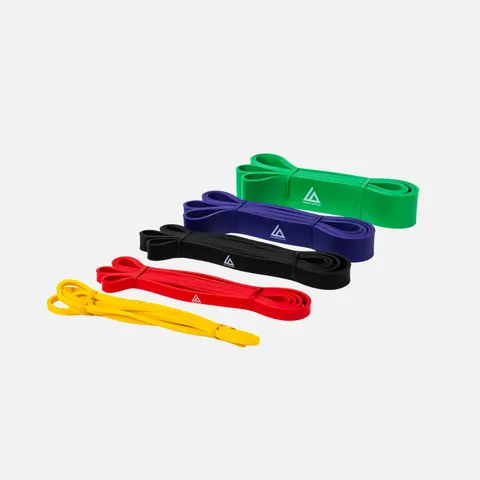
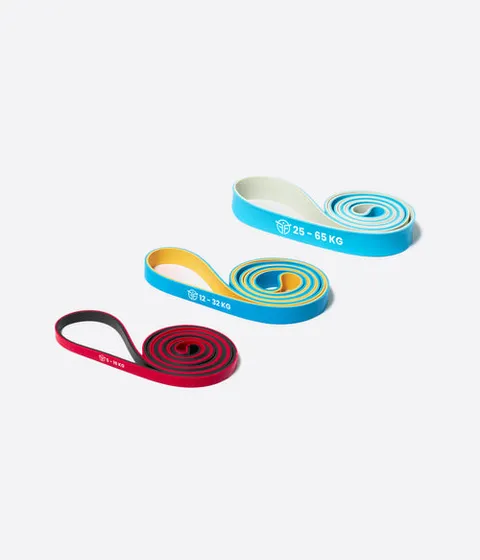
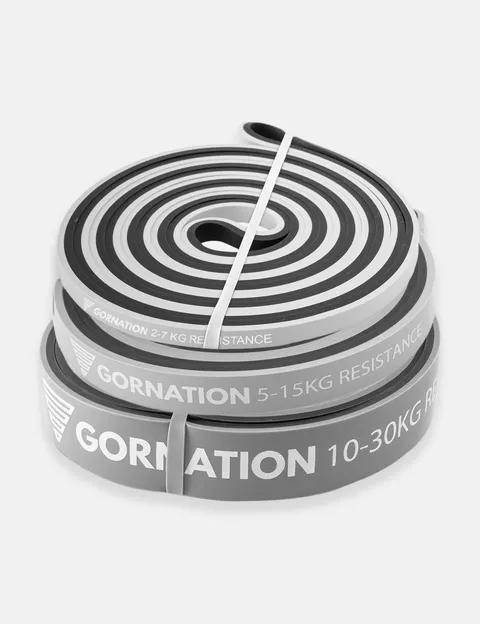
Bands are sold by the assistance they provide, usually as a range in kilograms. Gornation’s line is a clear example of how the levels are usually split: ultra light at 2 to 7 kg, light at 5 to 15 kg, medium at 10 to 30 kg, heavy at 20 to 40 kg.
If you are buying one band to learn pull-ups, take a medium. Heavy bands remove so much weight that the exercise stops resembling a pull-up.
If you are buying two, take a medium and a light. The medium gets you the first reps, the light is what you switch to a few weeks later, and that switch is the progression. Going straight from a heavy band to nothing is a gap most people cannot bridge.
Width is the physical proxy for resistance: the wider the band, the more assistance. Thickness matters too, but width is what you see on a product photo.
Latex quality and lifespan
Bands are layered natural latex. The quality difference between a cheap band and a good one shows up in how the layers are bonded, which is what fails first.
What actually destroys bands is sunlight and heat, not training. A band left on an outdoor bar through a summer will crack in months. The same band in a drawer lasts years.
Check the surface before you load one. Fine cracks across the width mean it is done. A band that fails under a pull-up snaps upward, towards your face.
Setting up safely
For assisted pull-ups, loop the band over the bar and pull one end through the other so it cinches. A band simply draped over the bar will slide sideways.
Foot or knee is a real choice. A foot in the band gives more assistance and less stability; a knee gives less assistance and is easier to hold. Start with the knee if you are wobbling.
Step into the band from a box or the bar itself rather than jumping into it. Most band accidents happen during setup, not during the set.
Never stretch a band towards your face, and never look down the line of a loaded band. This sounds obvious until you are threading one under a bar.
Which brands make resistance bands
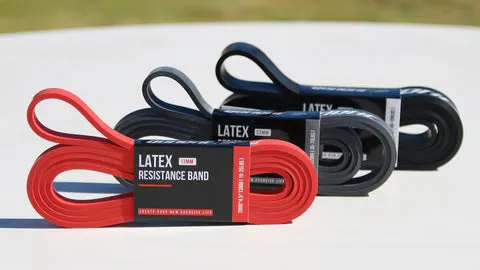
Gornation, Gorletic, Caliathletics and Eric Flag all sell resistance bands alongside their main calisthenics range.
FAQ
Which resistance band should I buy first?
One medium band, around 10 to 30 kg of assistance. It is the range that makes assisted pull-ups possible for most people without removing the work entirely.
Do resistance bands build real strength?
For assistance work, yes: they let you train the full movement with correct form before you can do it unassisted. As a standalone resistance, the tension curve is wrong for most calisthenics goals, because the band is easiest where the exercise should be hardest.
Loop bands or tube bands with handles?
Loop bands for calisthenics. They anchor to a bar and assist pull-ups, dips and muscle-ups. Tube bands with handles suit isolation work, which is not what most calisthenics training needs.
How long do resistance bands last?
Natural latex bands last years indoors and much less outdoors. UV and heat are what kill them, not use. Store them out of direct sun and check for surface cracks before loading one.
Can I use a band instead of a pull-up bar?
No. A band needs something to anchor to. See the pull-up bar guide for what to mount and where.