Parallettes for Calisthenics: Types, Brands & Buying Guide
Complete guide to parallettes: low vs high, wood vs steel, best brands for planche and L-sit training. Choose the right pair for your level.
What are parallettes?
Parallettes are short parallel bars placed on the floor, used in calisthenics and gymnastics training. The name comes from “parallel bars” - the full-size gymnastics apparatus. Parallettes elevate your hands and allow a neutral grip, which reduces wrist strain and gives more range of motion for pressing and compression work.
Parallettes exercises
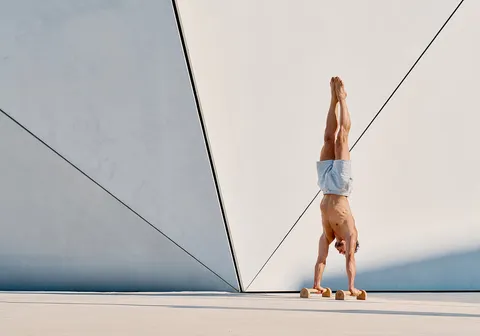
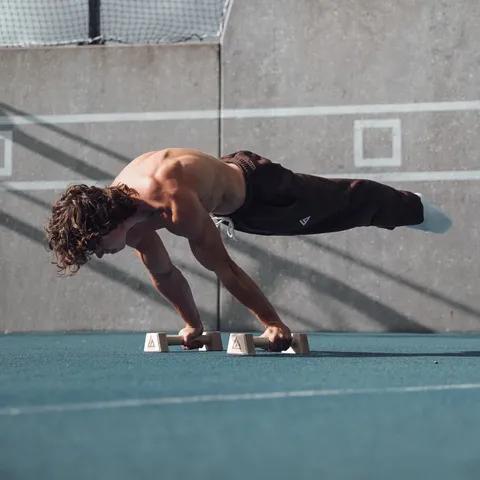
For planche training, parallettes are the standard surface at every stage from tuck planche through to the full hold. The rigid fixed base is better for shoulder alignment during long holds than bars or rings, which have some flex.
L-sits are another natural fit (see the L-sit progression for the steps). The elevated grip lets you press down without pushing the wrist into extension - which is why parallette L-sits tend to be more comfortable than floor holds when starting out. Most people train L-sits on parallettes early and move to bar or floor holds later.
For push-up variations - deficit push-ups, archer push-ups, Bulgarian push-ups - parallettes hold the torque better than push-up handles, which rotate. High parallettes (20 cm or more) also cover dips (more range than most fixed dip bars) and deficit handstand push-ups, the step after the handstand progression.
Pike push-ups and planche push-ups round out the common uses. If a movement needs a stable, slightly elevated hand position, parallettes work.
Low parallettes vs high parallettes
| Low (4–8 cm) | High (15–30 cm) | |
|---|---|---|
| Best for | Planche, L-sit, compression | Dips, deficit HSPU, push-ups |
| Center of gravity | Close to floor (ideal for horizontal holds) | Elevated (more range for vertical pressing) |
| Storage | Very compact | Bulkier |
| Who needs them | Anyone doing planche or statics | Athletes adding dips or HSPU |
Most people start with low and buy high later, if at all. High parallettes only become relevant once your training regularly includes dips or deficit HSPU.
Some brands sell adjustable-height models. Worth considering if you want one pair to cover both use cases.
Wood, steel or PVC?
| PVC | Steel | Wood | |
|---|---|---|---|
| Rigidity | Low to moderate | High | High |
| Weight | Light | Heavy | Medium |
| Grip texture | Smooth | Smooth (often knurled) | Natural, absorbs sweat |
| Price | Low | Medium to high | Medium to high |
| Best for | Beginners, light static work | Dynamic movements, heavy athletes | Home training, planche work |
PVC is the cheapest option. It flexes under load, which you feel at higher bodyweight or during dynamic movements. Fine for starting out.
Steel holds any load without flex and is the most durable long-term. Heavier, which also helps it stay put on smooth floors.
Wood (usually beech or oak) is rigid, handles sweat better than bare metal, and is lighter than steel. Most people doing serious home training end up with wood or steel.
How to choose
For beginners, low PVC parallettes are a reasonable first buy. Affordable, they cover L-sits, tuck planche, and push-up progressions without issues.
Once you are working toward full planche or consistent dips, steel or wood is worth the upgrade. You will feel the stability difference as hold times get longer.
If you can only buy one pair, go with low parallettes in wood or steel. They cover the most common use cases and hold up long-term.
Which brands make parallettes
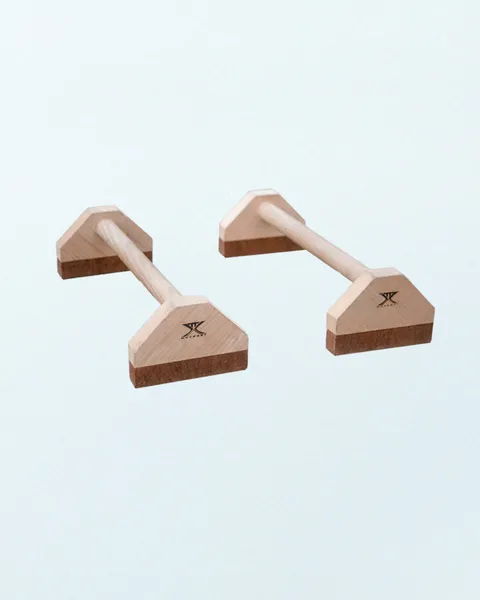
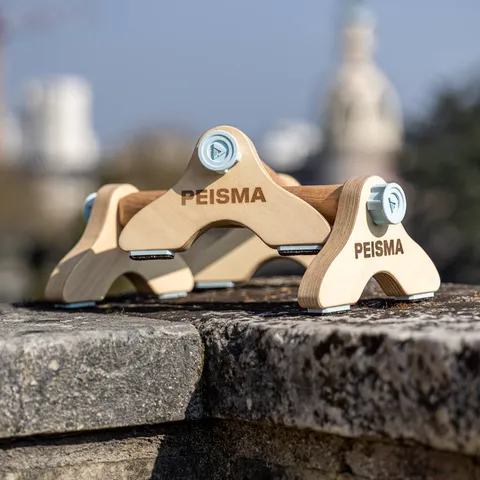
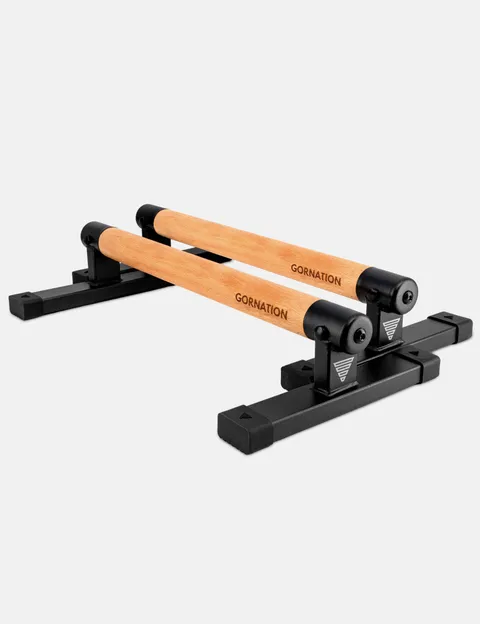
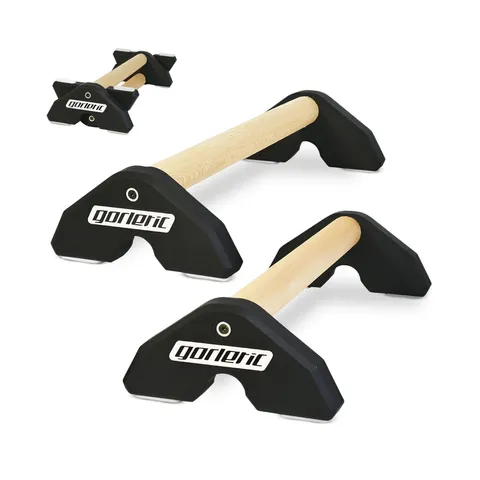
Gornation, Gorletic, Caliathletics, Eric Flag, Peisma and MX-Sport all sell parallettes into the European market. Peisma and MX-Sport manufacture theirs in France.
Grip and wrist technique
Place hands at the center of the bar, fingers wrapping around the front. Keep wrists in line with the forearms. For planche, angling the knuckles slightly forward (30 to 45 degrees) helps with shoulder alignment and reduces forearm tension.
Wrist discomfort in the first weeks is normal - connective tissue adapts slowly. Build volume up gradually. Muscle soreness is expected; sharp joint pain is not. Stop if you feel the latter.
FAQ
Are parallettes worth it?
For planche or L-sit training, yes. The wrist angle alone changes how much volume you can handle comfortably. For general push-up work, useful but not essential.
What parallettes for planche training?
Low (4 to 8 cm), wood or steel. Minimal elevation keeps the body close to horizontal. Rigidity matters more than anything else at advanced planche levels.
Parallettes vs floor for L-sit?
Parallettes let you train the L-sit before your wrists are ready for flat-palm floor holds. Most people start on parallettes and move to floor or bar holds later.
How tall should parallettes be?
Low (4 to 8 cm) for planche and statics. High (15 to 30 cm) for dips and deficit HSPU. If buying one pair, go low.
Can I replace parallettes with push-up handles?
No. Push-up handles rotate under load by design. Parallettes are fixed. For static holds, that difference matters.
Can parallettes replace a pull-up bar?
No. Parallettes cover pushing and compression movements only. They complement a pull-up bar, not replace it.
Parallettes or dip bars?
Height decides. Parallettes sit 4 to 30 cm off the floor and serve planche, L-sit and push-up work. Dip bars are tall enough for full dips with the legs hanging. If you train both, you want both; if you buy one pair first, low parallettes cover more of a statics athlete’s training.
Do parallettes help with wrist pain?
Often, yes. A neutral grip removes the wrist extension of flat-palm work, which is what hurts most people in push-ups, handstands and L-sits. They do not fix a wrist that is already inflamed: reduce volume and warm the wrists up before each session.